Showing posts with label Fashion. Show all posts

Tuesday, November 1, 2011

Fashion Tapas: Late 20's Style Cloche

Ms. Gish Crochet Cloche by KnotChaCha

It’s a cloche with a tiny flare at the bottom. Just enough of a flare to still call it a cloche. Anything less and you’d have to call it a beanie. The crown is a solid charcoal wool and as the hat swoops down toward the tiny flip of a brim charcoal and black wool alternate in a spiral stripe that ends in a black edge. A vertical row of simple buttons decorates one side.

With this low profile cloche you could picture yourself in the late 1920s, a time when in fashion and actions women had been making statements all decade about their independence and worth.

As the decade of the twenties wound to a close, "talkies" were replacing silent films and Ms. Gish’s acting career was slowing down. By 1929, the cloche hat had evolved so that it only had the tiniest of brims—similar to what you see on this hat. Ms. Gish did not appear on screen during that year. I’d like to think that while she was not working she might have crocheted a hat like this for herself or a friend.

Wednesday, October 12, 2011

Mrs. Chaplin's Cloche

Valerie is so excited to be back home modeling hats again, and loves to show off this new design of mine:


The classically-shaped two-color cloche has a brim that can be worn down or turned up on one side. A simple button-flower decorates one side:


This hat design will be produced in two sizes. The smaller size (women's Sm/Med) will work best for head circumferences 21-22 inches and the larger size (women's Med/Lg) for a 22-23 inch measurement. I'll be listing some in the shop by this weekend. Be sure to stop by and see some of the color combinations. The one featured here is in burnt orange and plum.

Monday, August 15, 2011

Fashion Tapas: Beaded Purses


Here are some of the purses that were on display at the Pittock Mansion. The exhibit was not set up for photography, so please pardon the poor quality of the photos. Still, you can glimpse enough detail to appreciate the incredible workmanship of these bags.

Steel beads embroidered on velvet drawstring bag.


Beaded knitting on a bag constructed of two circles with a wrist loop.


Embroidery and bead embroidery on a small frame bag.


Dense bead embroidery on a frame bag.

Crocheted beaded rings and bead fringed frame bag

Frame bag of beaded knitting with stranding and loops

Drawstring bag of beaded knitting with stranding between stitches

Bead knitting with beaded fringe
Some of Mrs. Pittock's personal collection. Tapestry bead knitting.

Monday, May 23, 2011

Fashion Tapas: Yarn Ball Up-do

If you look this beautiful, you can get away with a dramatic yarn ball hairdo. Not so great would it look on me, and I might be carted off to the funny farm; however, I'm tempted to wear this look to the office one day.

Photo by Tima Sergeev
Check out Tima's other great pictures from this photoshoot by clicking on the link.

Monday, January 31, 2011

Fashion Tapas: What Was Up Her Romantic Sleeve?

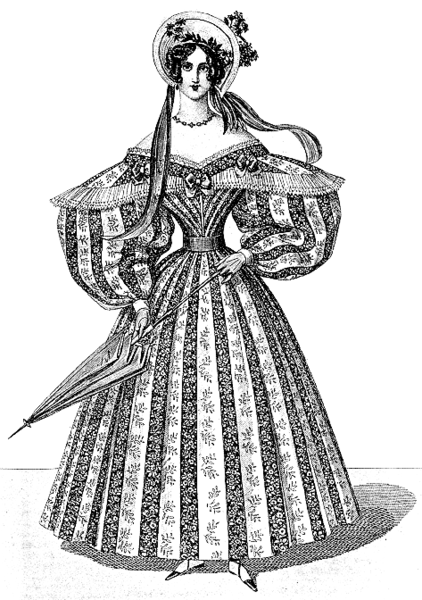
In the last Fashion Tapas feature we saw some lovely dresses worn during the romantic fashion period which was at its peak during the 1830s. The iconic hourglass figure was seen to an extreme in this silhouettte in which the measurement from shoulder to shoulder on the dresses often would be as much as 27-29 inches across. This extreme width was meant to balance the width of the bell-shaped shirt.

1835 Weiner-Zeitschrift Fashion Plate from Wikipedia Commons

Notice the relative position of these sleeves at the middle of the arm in the middle of the decade. Remember, the poof started high and then worked its way down the arm.

You might well asked how these voluminous sleeves stayed so puffy instead of just collapsing under the pull of gravity. That trick was accomplished by the sleeve undergarment.

One method of supporting the sleeves was a gathered piece of fabric with whalebone at its edge or a hooped undersleeve like the one in the next photo which also shows a corset and a petticoat shaped with pin tucks.

Corset & Petticoat 1830, The Metropolitan Museum

Another favorite method for supporting the sleeves was to wear sleeve plumpers underneath. They were inner sleeves that would be filled with down or feathers. Imagine wearing little pillows on your shoulders. Here's an example:

Sleeve plumpers and corset, Fashioning Fashion Exhibit, LACMA

Also note that the corset has a separate padded compartment for each breast and ties in the front so that the wearer could lace it without an assistant dresser. The corsets of this period created a tiny, higher than natural waist. A fine discussion of corsets from this period, along with illustrations, can be found at the website for Lara's Corsets and Gowns.

If you would like to see a zoomable image of another set of sleeve plumpers, to get a closer look at these charming sleeve pillows, visit this page at the digital archives of the Kyoto Costume Institute.

There were several distinctive sleeve types in this period:

My favorite is the beret sleeve which was cut from a large piece of circular fabric. A hole cut in the middle of the fabric was attached to the arm band and the circumference of the fabric was attached at the shoulder in sharp pleats  that were supported inside by horsehair or buckram. Also inside could be found some ties used to adjust the volume of the sleeve.

Beret Sleeves, Fashioning Fashion Exhibit, LACMA

The puffed sleeve, when really large, became a balloon sleeve. When it billowed from shoulder to wrist, it was sometimes referred to as a imbecile sleeve. You can see an example in the first illustration of this post.

The gigot or leg of mutton sleeve was full at the top and narrow at the lower arm. A daintier, slimmer version appeared later during the Victorian era.

Sleeves were a key feature of this romantic period, but what interests me are the fashion accessories. in the next Fashion Tapas feature we will take a look at some.


Wednesday, January 19, 2011

Fashion Tapas: When Puffiness Was In Vogue--The Hourglass Figure

Do you remember ever wearing a dress with puffed sleeves? Perhaps it was a favorite childhood dress or a prom dress or bridesmaid's dress in the 1980's. In any case, you may remember that the dress felt romantic and feminine, befitting the history of those sleeves.

The Romantic Period of clothing is roughly given as the years from 1825-1840. It was the era of the quintessential hourglass figure, and it stood in contrast to the more slender Empire silhouette of 1795-1820 which emulated classical Greek and Roman lines. The clothing was exceedingly bulky and puffy--something most women today would avoid.


A key feature of this period was a sloping, broad-shouldered upper body accented by very large sleeves. The ideal shoulder width was equal to the width of the period's voluminous bell-shaped, ankle-length shirt. Between the two was found that tiny romantic waist that attracted suitors. The style was distinctively round-bosomed with a bare décolleté for evening.

At the beginning of the Romantic period the waistline was lowered slightly from the previous Empire fashion. As the period continued, it moved increasingly downward toward the natural waistline.


In 1830 you would find that most of the sleeve fullness was over the upper arm but by the middle of the decade the fullness has crept down toward the elbow as in this evening dress:


By 1840 the puff is at the lower arm, ending at the wrist, and the waist is finally where is occurs in nature.


In the next decade the sleeve puffiness disappears and is replaced by a natural shoulder line and narrower sleeves. The waist stays tiny and the skirt stay full and lengthens to the floor.

In next week's Fashion Tapas feature, we'll take a look at what the romantic woman had up her sleeve and how she got that itsy-bitsy waist. Meanwhile, if you are interested in reading more, check out the twelve fascinating monthly issues of The Royal Ladies Magazine from 1831.

Friday, September 3, 2010

Autumnal Gold

There was a time when I couldn't stomach fall colors. It was a reaction to having seen too much avocado green shag carpet and too many harvest gold kitchen appliances in the 1970s. I blasted into the eighties with a reactionary craving for jewel tones like everyone else.

So it came as a surprise when I found myself in the last few years loving green, brown, gold, rust, orange and wine. In defense, the current go-round of harvest hues are more saturated and clear, whereas the 1970's versions were from a dull and muted palette.

This post has some selections in beautiful gold for your viewing pleasure.

by Amaia


by laslopezlas


by ao3designs


by PaleFireDesigns


by fibercottage

Thursday, September 2, 2010

Cinnamon, Brown Sugar, & Caramel

All those good Autumn flavors are waiting to be sampled. I'm ready for a rainy afternoon spent knitting in a local yarn store by a gas fireplace or sipping hot chai latte at a coffee shop while reading a good thriller.

Who am I kidding? A knitwear accessory store owner doesn't get much time to lounge around reading novels all afternoon. Not at this time of year.

Here are some lovely handmade choices to spice up an Autumn wardrobe.

by flutter


byPaleFireDesigns


by eweniquelyewe


by thebijoubabe


Brown Sugar Vintage Redo
by Cloezilla


by octaviabloom

Tuesday, August 31, 2010

Orange You Glad

Summer's almost over.

I always get excited in the Fall. It's a holdover from school days. The excitement about a box of freshly sharpened pencils, the smell of new crayola crayons, or crisply pressed school uniforms was hard to contain. It was second only to the anticipation of what novel things we might learn in the coming term.

September, more than January, has always seemed more like the beginning of the year.

Fresh from a holiday at the ocean, I spent some time this evening combing Etsy stores to see what wonderful fall accessories were being offered in some of my favorite Autumn colors.

Here are some beauties in burnt orange:


by amysfunkyfibers


Friday, January 8, 2010

L.A. Fashion

It was our first trip to L.A. and yours truly packed all the wrong things.

In my little pea brain, I was thinking that since we would be staying right by the beach, I should take a quantity of casual beach clothes like we might wear here in Oregon and some sandals--both beach and dress types. Also some khaki cargo pants and a pair of tennis shoes for walking around. One dress outfit for going dancing and one dressy pair of back pants.

I imagined it would be a balmy 70 degrees and packed accordingly, but I did take a bulky Oregon casual coat for our planned arrival back here at midnight.

No one told me about the SoCal dress code, and I should have studied the weather report more closely.

The first afternoon and evening we spent exploring Santa Monica. I don't think it was much above 60 degrees in the afternoon and not quite 50 after sunset. It was jacket weather, for sure; however, if you looked at the Santa Monica shoppers on the 3rd Street Promenade, you'd swear it was a mere 20 degrees outside.

The 3rd Street Promenade was lots of fun. Great shops. Hustle and bustle. There were Christmas shoppers hopping around toting packages galore.

All the women dressed pretty much alike. At least the women under thirty-five. (It didn't look like anyone much over forty was allowed to be seen on the street--at least not looking like they were over forty.)

Here's the current look for Santa Monica winter:
  • Boots are the most important winter accessory. Calf or knee high, worn tucked into the next item.
  • Skin tight black leggings or dark jeans on ultra thin legs.
  • A shorty jacket, preferably an expensive one.
  • A flirty scarf.
  • Long (mid-back length) layered hair, blowing free and usually not covered by a hat.
  • Sunglasses, even when there is no sun. (Take them off an hour after sunset.)
The next evening while waiting in a movie theater lobby, I noticed the same fashion again and pointed it out to Mr. ChaCha. He started paying attention to the crowd and marveled with me that everyone was so chic but had such skinny legs.

Even more fun was shopping on Melrose Avenue. The styles were more funky and eclectic with a mix of young designer boutiques and vintage/resale stores. Some fun things were purchased to be crammed into my suitcase for the trip back to Oregon.

I wanted this hat, but the store was closed.


The store next door was also closed but had a great blouse. Can't you just picture it with the hat and a long pair of champagne-colored silk pants?


The silhouette for dresses, based on the fashion window displays, was exclusively a sheath style. The other non-pants look was pencil mini skirts with leggings or tights and lots of layering.


I didn't photograph that much fashion on this trip, but here are a few more photos. The next one is from a display done all in gold hues.


The next is a glimpse into a California boutique:


The last photo is for a dear perimenopausal friend who is craving hooker heels as part of her mid-life crisis. I guess these shoes are what you wear when not wearing boots in LA.


Before the next excursion to LA, some preplanning will be in order. First off, three months of Pilates classes to tone the legs. Then a trip to the hairdresser for a new do, and a facial to perk up the complexion.

Then I'll need to order some clothes from this great Santa Monica boutique, LF, where the young sales clerk was totally friendly even though I probably looked like one of the Clampetts to her. I commented on the great selection of clothes and boots in the store. She told me that they carry boots year round. She herself wears her boots in the summer with her dresses.

I told her of the irony that in Northern cold-weather cities, where boots are really needed, you can hardly find a pair in the stores after February or March.